






 (
( (
( (
(
Security camera catches a mom fighting off a raccoon to save her daughter
-
[image: mom saves daughter raccoon — Rhododendrites / CC BY-SA 4.0
(Wikimedia Commons)]
This scary video shows a mom saving her young daughter from a seemi...
Showing posts with label Sociology. Show all posts
Showing posts with label Sociology. Show all posts
Sunday, February 12, 2012
Saturday, November 19, 2011
"Illegal Limbo": Childhood and Immigration Status
Interesting short piece on the ASA (American Sociological Association) blog "Contexts" about the life-course of the children of non-status ("illegal") immigrants in the US.

All this has interesting (and expansive) cultural roots in the West - dating back as far as I know, to the Victorian Era, before which childhood was not necessarily associated with innocence. Okay, this is from Wikipedia, I know, but it's kindof "common knowledge" among sociologists, so trust me ;)

But why 18, you may wonder? Why is that most often the magic number? I just downloaded a bunch of papers, mostly from legal history journals, which I am too tired to read tonight. But I'm making a mental note for a future post entitled perhaps "Why 18?" or, alternatively, "Boy you 18 now, you grown, and you need to get yo'self a J. O. B.". Probably the former, though.
In 1982, the Supreme Court ruled that children of undocumented immigrants have the right to a free public school education alongside native-born children. But when these undocumented kids leave high school, they transition from protected child to illegal immigrant. That is, the laws support the undocumented child, but not the undocumented adult they’ll eventually become. Roberto G. Gonzales (American Sociological Review, August 2011) explores how these youth experience their status transformation through interviews with 150 “1.5-generation” Latinos in California.

A man and his son wave the flag of El Salvador at an immigration rally in New York City.
It's an interesting and little-discussed side of the "illegal immigration" debate in the US. It also highlights the arbitrariness of much of the discourse about "saving the children", and of children's right to fair treatment and equal opportunity, a set of entitlements that have a clear and definite expiry date (your 18th birthday). You see this false distinction again when it comes to popular discussions of children and gangs, imprisonment, poverty, etc. After that point, the discourse shifts from "victim" to "perpetrator", from "innocent" to "guilty" as arbitrarily and suddenly as we go from child to adult. Am I right?Adolescents, Gonzales writes, first recognize their illegal status in their late teens, when their lack of a Social Security number prohibits such rites of passage as getting a part-time job or a driver’s license. Assimilation alongside their native-born peers led these kids to believe they would have more opportunities than their parents, but undocumented youth get a harsh reality check at graduation: no papers means no future. The young adults must “learn to be illegal,” which includes re-evaluating their future goals. And parents—who often believed that their children would have citizenship by the time they reached adulthood—don’t prepare them for this transition.Despite speaking fluent English and earning high school (and sometimes college) degrees, undocumented young adults end up no better off in the labor market than their uneducated parents. Gonzales argues that the system has created a “new disenfranchised underclass”—2.1 million young adults who are stuck in what might be called “illegal limbo.” Link
All this has interesting (and expansive) cultural roots in the West - dating back as far as I know, to the Victorian Era, before which childhood was not necessarily associated with innocence. Okay, this is from Wikipedia, I know, but it's kindof "common knowledge" among sociologists, so trust me ;)
It's all very ironic, of course, given how prevalent and brutal child labour practices were, but also highlights the bourgeois origins of the discourse.
The man usually credited with - or accused of - creating the modern notion of childhood is Jean Jacques Rousseau. Building on the ideas of John Lockeand other 17th-century liberal thinkers, Rousseau formulated childhood as a brief period of sanctuary before people encounter the perils and hardships of adulthood. "Why rob these innocents of the joys which pass so quickly," Rousseau pleaded. "Why fill with bitterness the fleeting early days of childhood, days which will no more return for them than for you?"The Victorian Era has been described as a source of the modern institution of childhood. Ironically, the Industrial Revolution during this era led to an increase in child labour, but due to the campaigning of the Evangelicals, and efforts of author Charles Dickens and others, child labour was gradually reduced and halted in England via the Factory Acts of 1802-1878. The Victorians concomitantly emphasized the role of the family and the sanctity of the child, and broadly speaking, this attitude has remained dominant in Western societies since then. Link

But why 18, you may wonder? Why is that most often the magic number? I just downloaded a bunch of papers, mostly from legal history journals, which I am too tired to read tonight. But I'm making a mental note for a future post entitled perhaps "Why 18?" or, alternatively, "Boy you 18 now, you grown, and you need to get yo'self a J. O. B.". Probably the former, though.
Wednesday, November 16, 2011
Meth (cont'd)
The (fantastic) PBS documentary series Frontline did a show on meth a few of years ago, and it's definitely worth watching. Not only because of the almost unbelievable destructiveness and pervasiveness of the drug in some parts of the States, but also because the creators take a legal and structural approach to understanding the spread of meth, as well as the barriers to combatting it.
So they consider how, for example, laws restricting the importation of certain component chemicals that are only manufactured in India had measurable effects on addiction rates nationwide (less of the chemical imported meant less potent/addictive meth in the supply, and lower addition rates). In one of the more disturbing explorations, you also see how lobbyists from the pharma industry strove to block the passage of laws that would further restrict the dissemination of one of the key ingredient of meth (ephedrin or alternately, pseudoephedrine), which, importantly, are found in over-the-counter cold medicines.
So they consider how, for example, laws restricting the importation of certain component chemicals that are only manufactured in India had measurable effects on addiction rates nationwide (less of the chemical imported meant less potent/addictive meth in the supply, and lower addition rates). In one of the more disturbing explorations, you also see how lobbyists from the pharma industry strove to block the passage of laws that would further restrict the dissemination of one of the key ingredient of meth (ephedrin or alternately, pseudoephedrine), which, importantly, are found in over-the-counter cold medicines.
"The Meth Epidemic" tells the story of two potential solutions to the crisis and examines why neither was fully tried. In the mid-80s, the U.S. Drug Enforcement Administration first proposed controlling the retail sale of ephedrine and pseudoephedrine in cold medicines by having customers register at the counter and limiting how much they could buy. Pharmaceutical companies, however, resisted the DEA's plan. Allan Rexinger, a lobbyist for the pharmaceutical industry, felt the DEA was overreacting and unfairly punishing a legitimate business: "They have a different way of thinking. DEA agents carry guns; DEA agents are killed in the jungles of South America. But when you're working in Congress, you don't need to carry a gun. We felt like we were being treated just like a Colombian drug lord." Meanwhile, Gene Haislip, a former deputy administrator at the DEA, says: "They live in the business community, where the name of the game is to make money and sell product. They're highly skilled, very well organized and very well funded, and they can be quite formidable." Faced with a choice, the White House and Congress ultimately exempted cold medication from the regulatory proposals.Here is the full documentary.
Read more: http://www.pbs.org/wgbh/pages/frontline/meth/etc/synopsis.html#ixzz1dtmLzgmj
Wednesday, October 26, 2011
Sunday, October 2, 2011
Saturday, October 1, 2011
The Map of a Woman's Heart
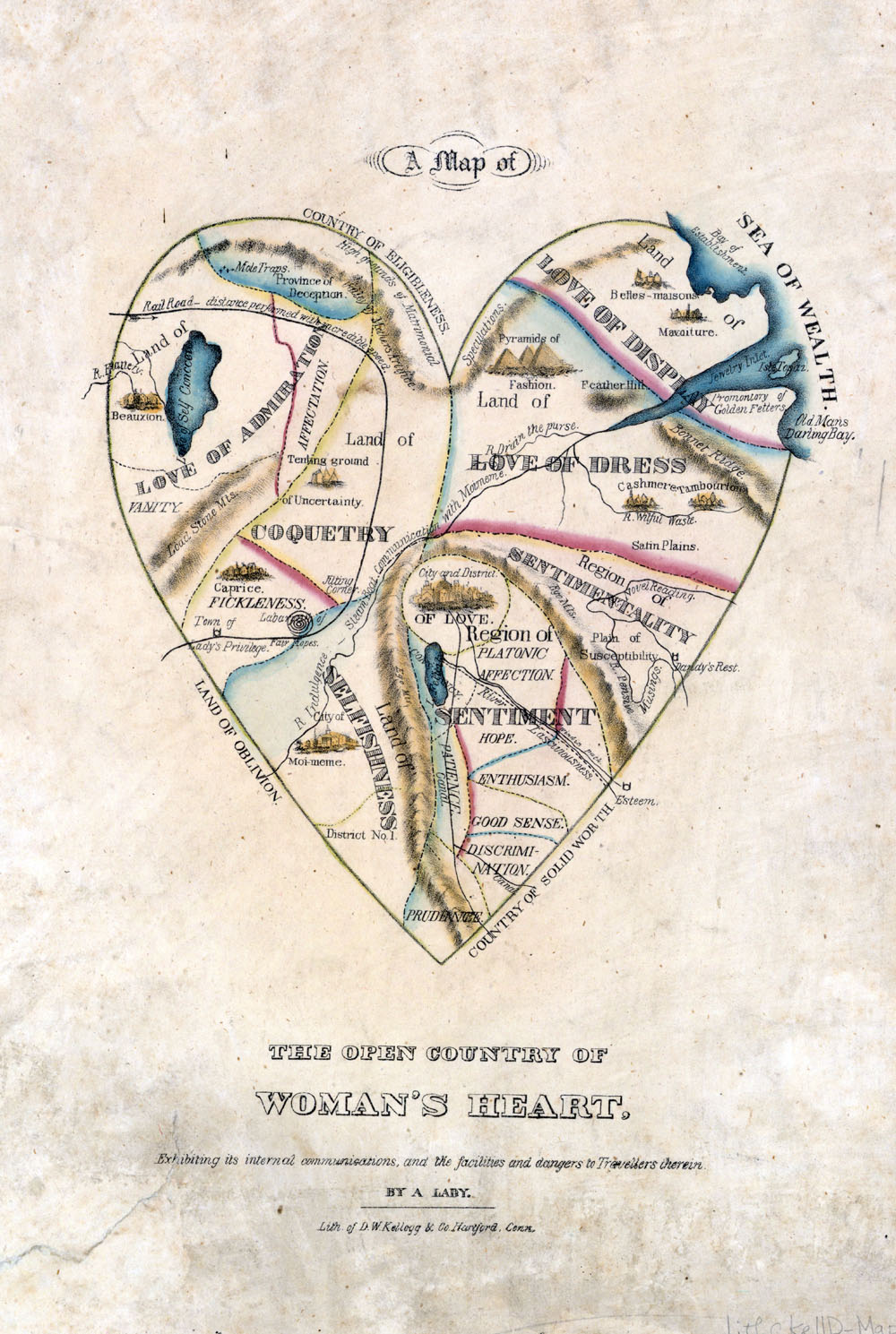
Nineteenth-century ideals of womanhood and beauty expressed as much about women as they did about the society in which they were germinated. At a time of radical sociocultural and economic shifts — rapid urbanization, new modes of transportation and communication, increasing mechanization of industry — the expectations for women’s role in society shifted as well, with an idealized version of what was known as “True Womanhood” underpinning pop culture representations of women in everything from newspaper advice columns to art.

Map of the Open Country of a Woman’s Heart was a map created by D. W. Kellogg circa 1833–1842, in the tradition of these maps of the human condition you might recall, subtitled “Exhibiting its internal communications, and the facilities and dangers to Travellers therein.” Though it mostly depicts Woman as a sentimental, selfish, and superficial being driven by vanity, it places Love at the center of her heart, with Good Sense, Patience, and Prudence at its tip — or bottom, depending on the interpretation.
Sunday, April 10, 2011
Chris Rock on race and "progress"
Interviewer: How do you think things have changed over the last couple of decades?
CR: Umm... white people have gotten less crazy. (...) You can say there is progress and all this, but... when you say it's "progress", you're acting like what happened before wasn't crazy. You know what I mean. So, "Oh, segregatio, we've made a lot of progress and there is no more segregation"... Segregation is re-tarded!..."
Saturday, March 19, 2011
The debate ends here.
Alex, Alex, Alex...You know what the problem here is?
You're just not a good young liberal white person. I love you and all, but there it is.
I can't have a dialogue with someone who works for a living, who pays these taxes I wish to disperse into the ether of human need, who has no aspirations that involve graduate school, or marrying an indie-ish chick with bangs (and perhaps an ironic tattoo). You may have gone to an Ivy League School, and wish to live by a body of water one day, but that's incidental... it's all incidental (Plus I think Wharton is like a small island of not-Ivyness in the otherwise beautiful clear Blue of the archipelago).
You're just not a good young liberal white person. I love you and all, but there it is.
I can't have a dialogue with someone who works for a living, who pays these taxes I wish to disperse into the ether of human need, who has no aspirations that involve graduate school, or marrying an indie-ish chick with bangs (and perhaps an ironic tattoo). You may have gone to an Ivy League School, and wish to live by a body of water one day, but that's incidental... it's all incidental (Plus I think Wharton is like a small island of not-Ivyness in the otherwise beautiful clear Blue of the archipelago).
You don't even drink coffee, for fuck's sake.
All you need to know is that I am a sociologist -- it is inscribed in the genealogy of my very profession to know what's best for poor people (this is also, incidentally, inherent to my whiteness ...Double-Rainbow.)
I work with immigration detainees, I am sensitive to the injustice of the world, and I am all 'round a more advanced person.
All you need to know is that I am a sociologist -- it is inscribed in the genealogy of my very profession to know what's best for poor people (this is also, incidentally, inherent to my whiteness ...Double-Rainbow.)
I work with immigration detainees, I am sensitive to the injustice of the world, and I am all 'round a more advanced person.
So just trust me on these things, ok?
( I know baba's with me on this. Hey, bro, facebook me)
Tuesday, February 1, 2011
Casting NYC in a different (red) light
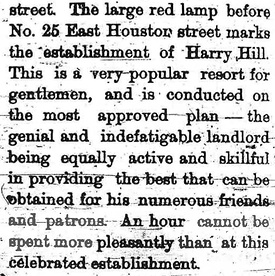
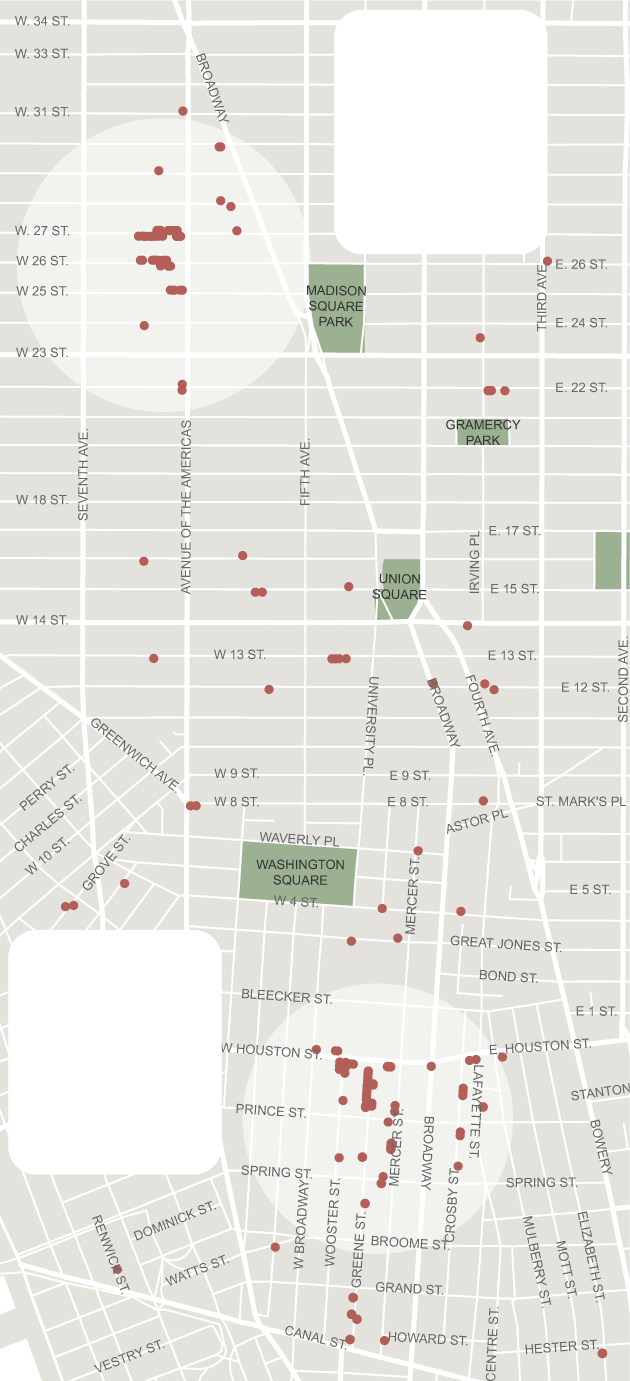
1870 GUIDE TO NEW YORK CITY BROTHELS
The New York Times has made available a digital copy of The Gentleman’s Directory, a guide to New York City published in 1870. The guidebook informs travelers of a particular type of local attraction: brothels. Of course, the information was for curiosity’s sake only:
Friday, January 21, 2011
Wednesday, December 22, 2010
Bourdieu, the "hipster", and the authenticity of taste
This was taken from a sociology blog, and talks about the the underpinnings of Hipster culture from a Bourdieuian perspective.
Pierre Bourdieu is a French sociologist who went into great detail theorizing on how the upper class's hold on power in society is in part its ability to dictate 'good' taste. He also detailed how each class in his France partakes in the hierarchy. Class is expressed in everything from taste in music, to style of dress, to how, what and how much food is presented to guests at a dinner party... These cultural schematas are internalized individually and collectively in what Bourdieu called habitus, and go a ways towards explaining how society is structured in terms of culture.
Basically, individualness is an illusion, and structure rules all... yay, sociology!
Subscribe to:
Posts (Atom)


